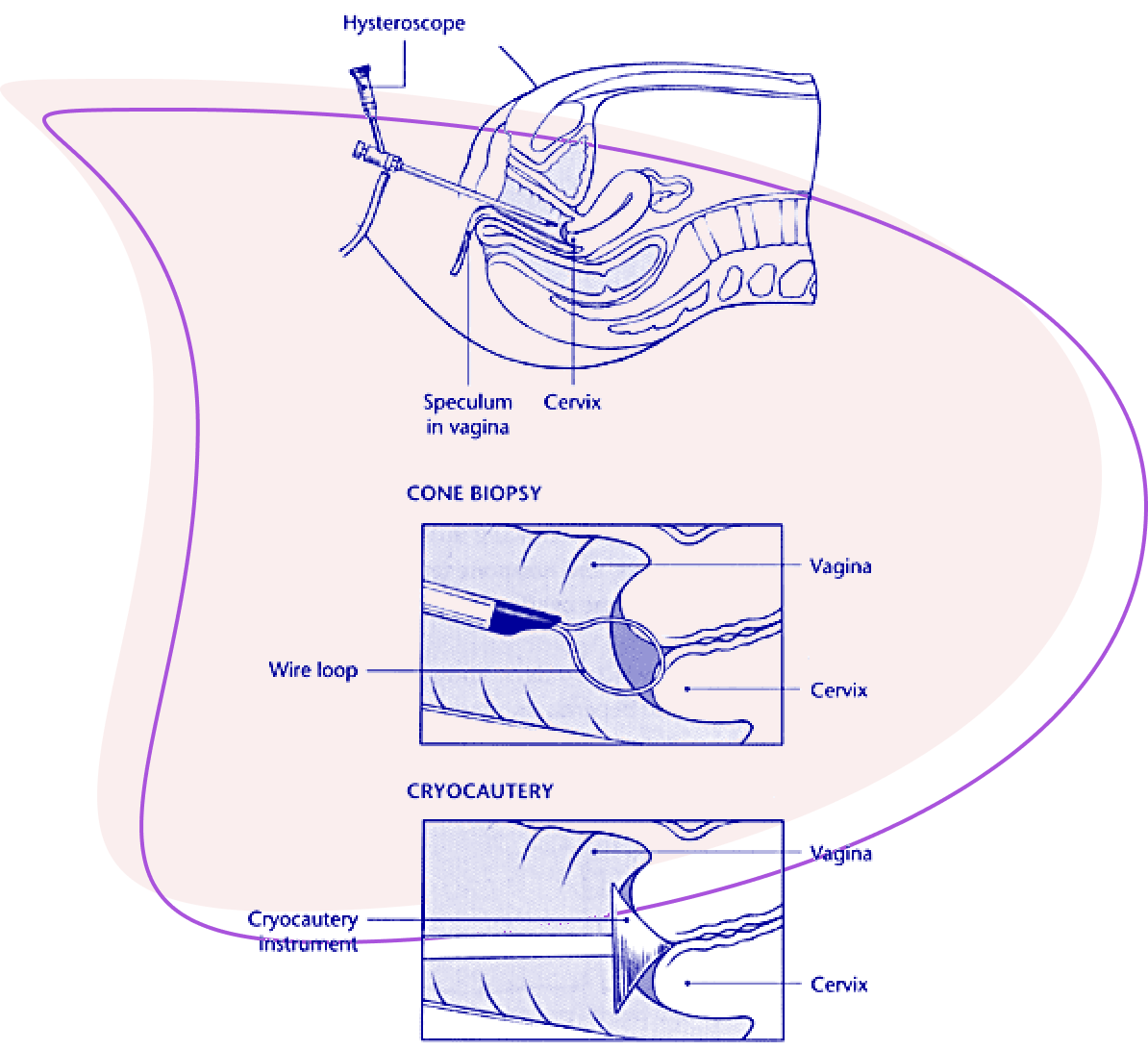
A colposcopy is carried out when abnormalities have been seen on
a cervical smear. The colposcope is a microscope which magnifies
the cervix and enables it to be examined more closely.
Colposcopy is a painless procedure performed in out-patients. An
instrument called a speculum is inserted to hold the walls
of the vagina apart and the cervix is then examined with the
colposcope.
Dilute acetic acid and iodine may be painted onto
the cervix in order to highlight any abnormal changes.
Small pieces of tissue called biopsies may be removed and
sent to the laboratory to be analysed.
There may be a small amount of bleeding following the procedure,
but normal activities can be resumed immediately.
If an abnormality is present, it may also be treated
at this first visit.
Cone biopsy and cryocautery of the cervix are two methods used
to remove abnormal cervical cells.
Cone biopsy may be performed in out-patients under local
anaesthetic or as a day-case operation in theatre under general
anaesthetic. Cryocautery is a painless procedure carried out in
out-patients.
In both procedures, an instrument called a speculum is inserted
to hold the walls of the vagina apart and the cervix is
then examined with the colposcope. The colposcope is a
microscope that magnifies the cervix and enables it to be seen
more clearly.
For a cone biopsy, the area to be removed is highlighted using
iodine solution. A 'cone' of tissue, containing the abnormal
area, is then removed using either a hot wire loop or a
laser. If performed in theatre, the tissue may be removed
surgically and sent to the laboratory for examination.
For cryocautery, the abnormal cells are destroyed
by placing a freezing probe on the cervix for a few
minutes.
There may be some slight bleeding following these procedures. A
vaginal discharge, which is dark brown or black in colour
after cone biopsy, and light and clear after cryocautery,
may also occur for up to 6 weeks. Any other discharge,
particularly if offensive in smell, should be reported.
Sexual intercourse should be avoided until after the next
menstrual period to ensure that the cervix heals properly.
Normal activities can be resumed the following day.